
Offbeat: The world's most powerful information machine
A sinking ship. A nuclear secret. A space shuttle disaster. The market knew before the investigation did.

The stock market is not just a place where people buy and sell shares.
It is the world’s largest information processing machine. And sometimes, it knows things that no official investigation, no government commission, and no public announcement has yet revealed.
Three stories. All true. All remarkable.
1. The Titanic, 1912
When the Titanic sank in the early hours of April 15, 1912, the world was in shock. The unsinkable ship was gone.
The parent company of White Star Line, which operated the Titanic was International Mercantile Marine Company, listed on the stock exchange. The ship had cost $7.5 million to build and carried only $5 million in insurance. The uninsured loss was $2.5 million.
Nobody ran a calculation. Nobody issued a formal assessment. The market simply opened and got to work.
Over April 15th and 16th, IMM Co. stock fell 25.3% on a market-adjusted basis. The dollar value of the loss: $2.6 million.
Almost exactly the uninsured amount. To the dollar.
2. The Hydrogen Bomb, 1954
In the early 1950s the United States was developing a two-stage hydrogen bomb. The research was public knowledge. Which fissionable material was being used was a classified state secret.
An economist named Armen Alchian decided to find out. Not through government sources. Not through classified briefings. He simply analysed publicly available stock market data, looking for which mining and materials companies had seen unusual price movements.
The answer the data gave him: Lithium.
He wrote a paper. It was immediately confiscated by government officials who deemed it a threat to national security. It was destroyed.
The market had revealed a state secret using nothing but the price of publicly traded stocks.
3. The Challenger Disaster, 1986
January 28, 1986. Space shuttle Challenger launches at 11:39 AM and disintegrates seconds later.
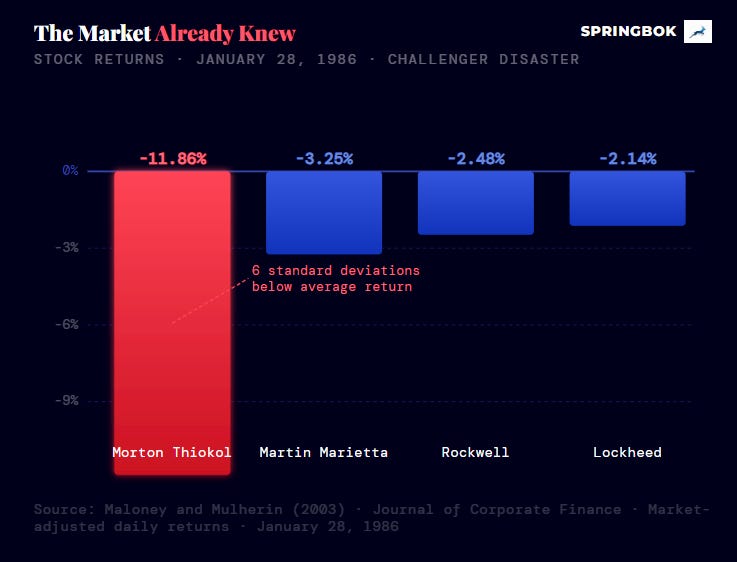
Four companies had supplied major components - Morton Thiokol, Lockheed, Martin Marietta, and Rockwell International. All four stocks fell immediately. All four companies said the same thing: no comment. No investigation had started. No cause had been identified.
But something separated Morton Thiokol from the other three.
While Lockheed, Martin Marietta, and Rockwell fell 2% to 3%, the kind of move you would expect from general uncertainty. Morton Thiokol collapsed 11.86% on the day. More than six standard deviations below its average daily return. Trading volume ran at seventeen times its three month average.
The market had identified the responsible party in hours.
Six months later a presidential commission confirmed it. The O-ring in Morton Thiokol’s booster rocket had become brittle in the cold and failed. The market had known all along.
What These Three Stories Have In Common
A ship sinking in 1912. A nuclear weapons program in 1954. A space shuttle disaster in 1986.
In each case, the stock market processed information faster, more accurately, and more completely than any official body, any investigation, or any individual analyst could.
Thousands of participants, each with their own piece of the puzzle collectively arriving at the right answer before the world knew what the question was.
Prices are not just numbers. They are the sum of everything the world collectively knows. Sometimes they know things that have not been announced yet. Sometimes they know things that are supposed to be secret.
The market is always talking. The job of an investor is to listen