
The Weekly Stack - Issue #1 (19th July to 25th July)
Nvidia locks in SK Hynix for $500 billion. Memory stocks crash 20%. The fundamentals and the price are telling different stories.

Every Saturday, Springbok Finance will publish The Weekly Stack a short, sharp update on the most important developments across the AI infrastructure universe.
No general commentary. No S&P 500 predictions. No Fed speculation.
Each issue covers five stories. For every story - what happened, why it matters for the thesis, and what we are watching next. Reading time under five minutes.
The Weekly Stack is not a news aggregator. Our job is to find the signal, connect it to the thesis, and get it to you before the market opens on Monday.
Issue #1 is below.
If you find it useful share it with someone who thinks seriously about markets and technology. That is how Springbok grows.
Know what you own. Know why you own it. Know when to sell
1. Nvidia and SK Group announce a $500 billion+ partnership - announced just hours ago
Nvidia and South Korea’s SK Group announced a $500 billion + partnership at an AI summit in San Francisco, signed in the presence of South Korea’s President. The deal has two parts. First, SK Telecom will build a massive AI data center using Nvidia’s latest chips, targeting 2 gigawatts of power capacity and coming online in 2027. Second, Nvidia and SK Hynix will jointly develop next-generation High Bandwidth Memory (HBM) - the specialized memory chip that sits inside every AI processor and makes it work. Nvidia CEO Jensen Huang called SK Hynix Nvidia’s largest memory partner and said the relationship “is going to grow substantially.”
One important clarification: The $500 billion figure is the total value of the entire initiative over many years and not a single cheque being written today. Think of it as the size of the relationship, not a single transaction.
Why it matters: The most important detail is not the headline number. It is that Nvidia and SK Hynix are now co-designing the memory chip itself, not just buying and selling it. When two companies build something together at that level, switching to a competitor becomes almost impossible. This is not just a supply deal. It is a technology partnership that locks in the relationship for years.
What we are watching: These are preliminary agreements, not final contracts yet. Watch for the formal signing. Also watch whether AMD moves quickly to secure its own memory supply before Nvidia locks up too much of SK Hynix’s production capacity.
2. Memory stocks have crashed over 20%, but the fundamentals have not
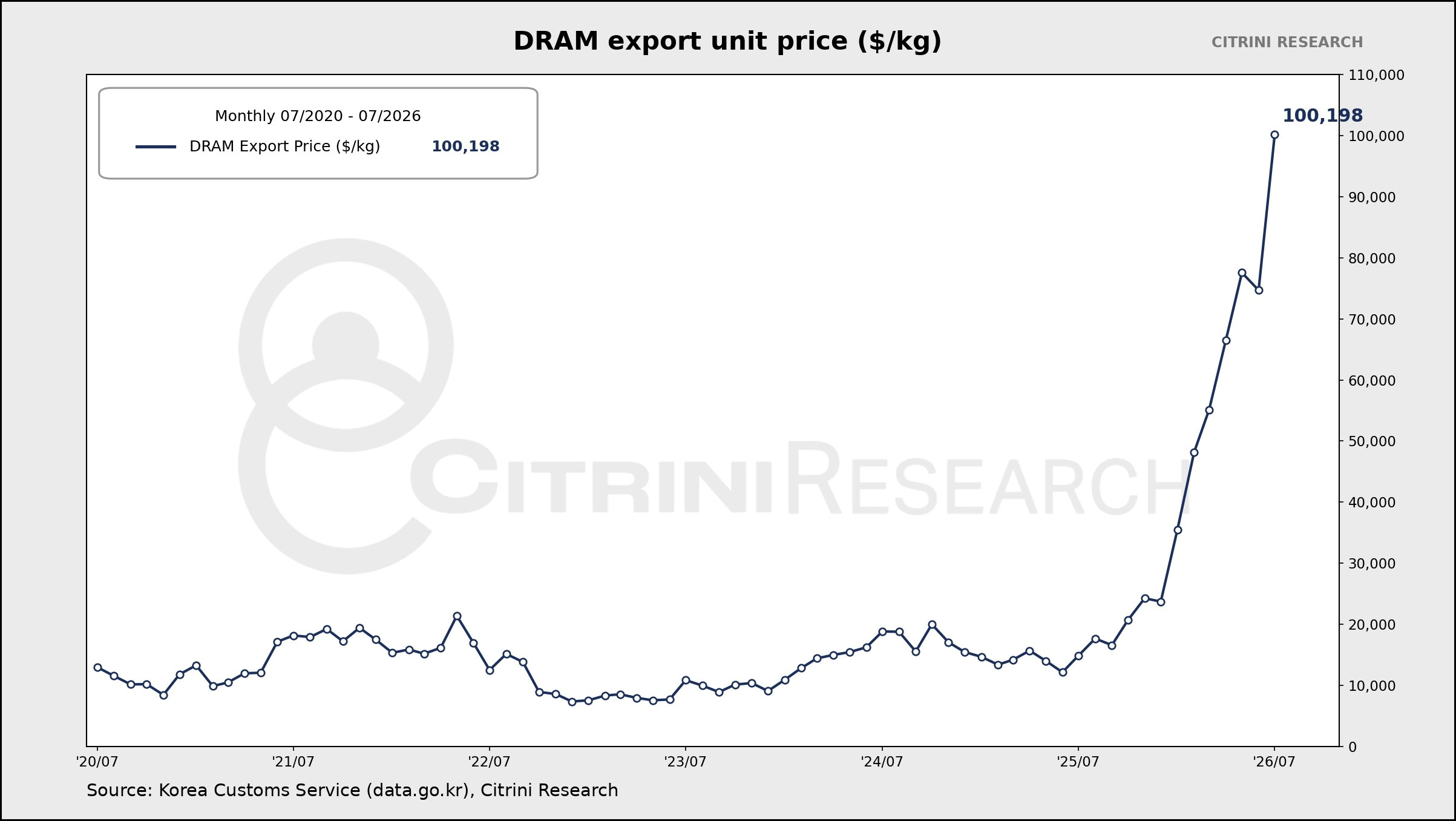
Micron, Samsung, SK Hynix, and memory stocks broadly have all fallen more than 20% from their recent highs, a bear market by definition. Here is the strange part: Samsung did not miss its earnings. It delivered record profits. The selloff is about fear, not fundamentals. Semiconductor stocks have lost roughly $1.5 trillion in market value since June 25. Micron is now trading at just 6 times next year’s expected earnings - the kind of valuation you normally see at the bottom of a cycle, not when a company is guiding to $50 billion in a single quarter.
Why it matters: The shortage of memory chips is not over. Deutsche Bank projects demand will outpace supply by nearly a third within two years. The business is stronger than it was six months ago. The stock price is lower. That gap between price and fundamentals is where returns come from.
What we are watching: SK Hynix reports earnings on Tuesday July 29. A strong result could reverse the entire correction in a single session.
3. IREN raises its revenue target after signing $2.8 billion in new deals
IREN signed $2.8 billion in new contracts with leading AI companies this week, raising its 2026 revenue target from $3.7 billion to over $4 billion. About 85% of that target is now locked in with signed agreements. The stock jumped 20% on the news, its best day in months after losing half its value from its May peak. New customers include Perplexity, Figure AI, and Hume AI, alongside Microsoft and Nvidia.
Why it matters: We held our $86 price target through the entire selloff because the contracts were not only intact, but growing. This announcement proves the business has not changed, only the sentiment did. The stock fell because investors got scared. The contracts kept getting signed anyway.
What we are watching: 85% of the revenue target is contracted. The remaining 15%, roughly $600 million is the next catalyst. Every new customer announcement closes that gap.
4. The memory shortage will last past 2030 - straight from the CEO
The CEO of SK Hynix, the world’s largest maker of AI memory chips warned this week that the global memory shortage will probably persist well beyond 2030. The reason is simple: AI data centers now consume roughly 70% of all memory chips produced worldwide, and building new factories to make more takes years. New production capacity will not be ready until 2027 at the earliest.
Why it matters: The CEO of the company that makes the chips is telling you the shortage lasts a decade. The stocks are down 20% from their highs. Those two facts are in direct contradiction, this where investors can make serious money.
What we are watching: Any announcement from Samsung about accelerating its own production. Samsung is the wild card, if it catches up to SK Hynix faster than expected, the shortage eases sooner.
5. Google reported earnings on Wednesday and raised its spending plans
Alphabet, Google’s parent company reported Q2 2026 earnings on Wednesday and raised its 2026 spending guidance to $195–$205 billion, up from $180–$190 billion. Almost all of that increase is going into AI infrastructure. Google Cloud, the division that competes with Amazon and Microsoft, grew 82% YoY in the quarter and now has a backlog of over $460 billion in future business.
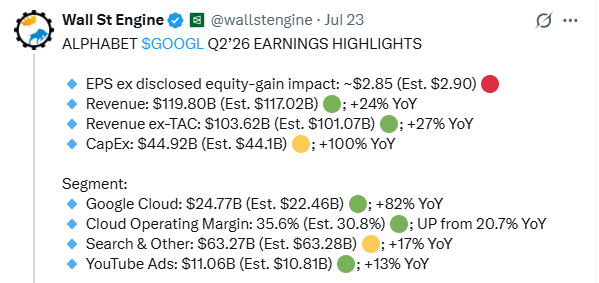
Why it matters: Every dollar Google spends on AI infrastructure flows through Springbok’s coverage universe. Google spends → Nvidia sells chips → SK Hynix and Micron supply the memory → IREN and the neoclouds house the data centers. This week saw memory stocks crash and neocloud sentiment collapse. Google’s earnings answer the question everyone was asking is AI spending slowing down? The answer is no. It is accelerating. The correction was about fear. The earnings are about reality.
What we are watching: Microsoft reports on Wednesday and Amazon reports on Thursday this week. If both confirm similar spending plans which current guidance suggests the crash in memory and neocloud stocks will look increasingly hard to justify.